Button Text! Submit original article and get paid. Find out More

Latest

Showing posts with label HACKING NEWS. Show all posts

Thursday, August 22, 2013

The PirateBrowser is very similar in many respects to the Tor Browser Bundle (which was recently exploited). As is the case with the Tor Browser Bundle, the open-source Firefox browser is at the core, though it's not the same version or release branch.
The Tor Browser Bundle is based on the Firefox Extended Support Release (ESR) branch, while the PirateBrowser is based on the Firefox Portable Edition, currently shipping with the recently released Firefox 23 browser. Firefox ESR differs from the mainline Firefox release branch in terms of the release cadence for major milestone updates. Firefox ESR aims to deliver a longer term of stability as opposed to the rapid rate of release from the mainline.

Read the full story at eWeek: 

Pirate Bay Builds Its Own Browser Bundle

HACKING NEWS

Pirate Bay Builds Its Own Browser Bundle

hgfv  |  at  7:05 AM

The PirateBrowser is very similar in many respects to the Tor Browser Bundle (which was recently exploited). As is the case with the Tor Browser Bundle, the open-source Firefox browser is at the core, though it's not the same version or release branch.
The Tor Browser Bundle is based on the Firefox Extended Support Release (ESR) branch, while the PirateBrowser is based on the Firefox Portable Edition, currently shipping with the recently released Firefox 23 browser. Firefox ESR differs from the mainline Firefox release branch in terms of the release cadence for major milestone updates. Firefox ESR aims to deliver a longer term of stability as opposed to the rapid rate of release from the mainline.
Read the full story at eWeek: 

Pirate Bay Builds Its Own Browser Bundle

Tuesday, August 20, 2013


In the "good ol days", "being deceived was not what it is today. When a time much of our personal information, name, address, bank account number, social security number, you can find online it is important to learn to wait and be aware of financial fraudsters.

Everyone is a potential target, target often considered elderly are "easier" than some of the objectives, as the generation that grew up with technology as those aged between 20 and 30 years on did. Not understanding what is normal and acceptable versus what is not devastating situations can lead to identity theft.

To avoid being scammed, you should be constantly on the lookout for suspicious situations such as:

Phishing e-mails. It is not uncommon to get an e-mail of what may seem to be your bank or other person with access to sensitive personal information. These e-mails often ask you to provide login information, bank account numbers or other sensitive information, banking on the hope that you will not notice that it is done Do you say you are.

Loans "pre-approved". Especially this is overwhelming, as it often goes with bad credit anyway. After being Abebooks web sites full credit for a purpose (which, of course, asks for information of all kinds), consumers are told they just have to wait for a processing fee fournisseur check out the loan. Of course, the share out the loan purpose is never received.

The fake antivirus programs. One of the most common scams consumers, ironically, provides protection against viruses ... if you just download the program. Although pop-up windows may seem legitimate, non-clicking on them will often result in the release of malware or viruses on your computer, a result that can be very difficult to fix. Another version of this would be in the form of a phone call from a "representative" of a company known computer says there is a problem with your computer. This will never be true.

Social media scam. Due to the type of social media, the virus can spread to all social networks incredibly fast. It can be in the form of a message Clicking All unleashes a virus that will start posting links to malicious virus that user profile. "Special Offers" and aussi contests are a common route for scammers, you offer great strength goal in his agreement to personal information and allow access to your account before delivery (All you normally do).

Randy Tye is a journalist specializing in issues related to fraud, finance, and financial mistakes. She lives in Boston and works as a system administrator for a small investment firm.
virus

4 Financial Scams to Avoid Online

hgfv  |  at  2:58 PM


In the "good ol days", "being deceived was not what it is today. When a time much of our personal information, name, address, bank account number, social security number, you can find online it is important to learn to wait and be aware of financial fraudsters.

Everyone is a potential target, target often considered elderly are "easier" than some of the objectives, as the generation that grew up with technology as those aged between 20 and 30 years on did. Not understanding what is normal and acceptable versus what is not devastating situations can lead to identity theft.

To avoid being scammed, you should be constantly on the lookout for suspicious situations such as:

Phishing e-mails. It is not uncommon to get an e-mail of what may seem to be your bank or other person with access to sensitive personal information. These e-mails often ask you to provide login information, bank account numbers or other sensitive information, banking on the hope that you will not notice that it is done Do you say you are.

Loans "pre-approved". Especially this is overwhelming, as it often goes with bad credit anyway. After being Abebooks web sites full credit for a purpose (which, of course, asks for information of all kinds), consumers are told they just have to wait for a processing fee fournisseur check out the loan. Of course, the share out the loan purpose is never received.

The fake antivirus programs. One of the most common scams consumers, ironically, provides protection against viruses ... if you just download the program. Although pop-up windows may seem legitimate, non-clicking on them will often result in the release of malware or viruses on your computer, a result that can be very difficult to fix. Another version of this would be in the form of a phone call from a "representative" of a company known computer says there is a problem with your computer. This will never be true.

Social media scam. Due to the type of social media, the virus can spread to all social networks incredibly fast. It can be in the form of a message Clicking All unleashes a virus that will start posting links to malicious virus that user profile. "Special Offers" and aussi contests are a common route for scammers, you offer great strength goal in his agreement to personal information and allow access to your account before delivery (All you normally do).

Randy Tye is a journalist specializing in issues related to fraud, finance, and financial mistakes. She lives in Boston and works as a system administrator for a small investment firm.

Sunday, August 18, 2013

The Federal Bureau of Investigation is using mobile malware to infect, and control, suspects' Android handsets, allowing it to record nearby sounds and copy data without physical access to the devices.
That's according to "former officers" interviewed by the Wall Street Journalahead of privacy advocate Christopher Soghoian's presentation at hacker-conflab Black Hat later today.


The FBI's Remote Operations Unit has been listening in to desktop computers for years, explains the paper, but mobile phones are a relatively new target.
It would never work with tech-savvy suspects, though: suspects still need to infect themselves with the malware by clicking a dodgy link or opening the wrong attachment. This is why computer hackers are never targeted this way – they might notice and publicise the technique, said the "former officers", who noted that in other cases it had proved hugely valuable.
Such actions do require judicial oversight, but if one is recording activities rather than communications, the level of authorisation needed is much reduced. A US judge is apparently more likely to approve reaching out electronically into a suspect's hardware than a traditional wiretap, as the latter is considered a greater intrusion into their privacy.
Gaining control of that hardware still requires a hole to crawl through; ideally a zero-day exploit of which the platform manufacturer is unaware.
The WSJ cites UK-based lawful spook spyware supplier Gamma International as selling such exploits to the Feds. The company was recently in the news after allegations that it was also supplying dodgy governments with kit - allegedly including malware disguised as the Firefox browser.
Given the convergence of mobile and desktop, it's no surprise to see desktop techniques being applied to mobile phone platforms by both hackers and law enforcement agencies.
The usual techniques of not opening unknown attachments or unsigned downloads should protect you against the FBI, just as it would against any spear-phishing attempt. But then again, if you know that, they probably wouldn't try using it against you. ®
News

FBI spooks use MALWARE to spy on suspects' Android mobes - report

hgfv  |  at  5:44 AM

The Federal Bureau of Investigation is using mobile malware to infect, and control, suspects' Android handsets, allowing it to record nearby sounds and copy data without physical access to the devices.
That's according to "former officers" interviewed by the Wall Street Journalahead of privacy advocate Christopher Soghoian's presentation at hacker-conflab Black Hat later today.


The FBI's Remote Operations Unit has been listening in to desktop computers for years, explains the paper, but mobile phones are a relatively new target.
It would never work with tech-savvy suspects, though: suspects still need to infect themselves with the malware by clicking a dodgy link or opening the wrong attachment. This is why computer hackers are never targeted this way – they might notice and publicise the technique, said the "former officers", who noted that in other cases it had proved hugely valuable.
Such actions do require judicial oversight, but if one is recording activities rather than communications, the level of authorisation needed is much reduced. A US judge is apparently more likely to approve reaching out electronically into a suspect's hardware than a traditional wiretap, as the latter is considered a greater intrusion into their privacy.
Gaining control of that hardware still requires a hole to crawl through; ideally a zero-day exploit of which the platform manufacturer is unaware.
The WSJ cites UK-based lawful spook spyware supplier Gamma International as selling such exploits to the Feds. The company was recently in the news after allegations that it was also supplying dodgy governments with kit - allegedly including malware disguised as the Firefox browser.
Given the convergence of mobile and desktop, it's no surprise to see desktop techniques being applied to mobile phone platforms by both hackers and law enforcement agencies.
The usual techniques of not opening unknown attachments or unsigned downloads should protect you against the FBI, just as it would against any spear-phishing attempt. But then again, if you know that, they probably wouldn't try using it against you. ®

Image from khalil-sh.blogspot.ru

Image from khalil-sh.blogspot.ru
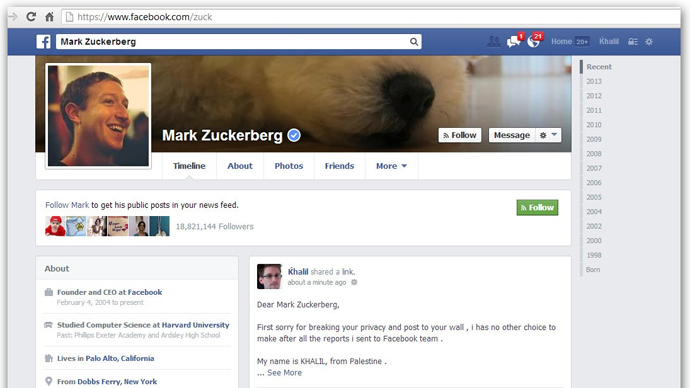
A Palestinian information system expert says he was forced to post a bug report on Mark Zuckerberg’s Facebook page after the social network’s security team failed to recognize that a critical vulnerability he found allows anyone to post on someone's wall.

The vulnerability, which was reported by a man calling himself ‘Khalil,’ allows any Facebook user to post anything on the walls of other users - even when those users are not included in their list of friends. He reported the vulnerability through Facebook’s security feedback page, which offered a minimum reward of US$500 for each real security bug report. 
However, the social network’s security team failed to acknowledge the bug, even though Khalil enclosed a link to a post he made on the timeline of a random girl who studied at the same college as Facebook CEO Mark Zuckerberg. 


“Sorry, this is not a bug,” Facebook’s security team said in response to Khalil’s second report, in which he offered to reproduce the discussed vulnerability on a test account of Facebook security expert. 

Image from khalil-sh.blogspot.ru
After receiving the reply, Khalil claims he had no choice but to showcase the problem on Mark Zuckerberg’s wall. 
Screenshots on his blog show that Khalil shared details of the exploit, as well as his disappointing experience with the security team, on the Facebook founder’s wall. 


Image from khalil-sh.blogspot.ru

Image from khalil-sh.blogspot.ru
Just minutes after the post, Khalil says he received a response from a Facebook engineer requesting all the details about the vulnerability. His account was blocked while the security team rushed to close the loophole. 

After receiving the third bug report, a Facebook security engineer finally admitted the vulnerability but said that Khalil won’t be paid for reporting it because his actions violated the website’s security terms of service. 


Although Facebook’s White Hat security feedback program sets no reward cap for the most “severe” and “creative”bugs, it sets a number of rules that security analysts should follow in order to be eligible for a cash reward. Facebook did not specify which of the rules Khalil had broken. 


Somewhere between the second and third vulnerability reports, Khalil also recorded a video of himself reproducing the bug.  

In its latest reply, Facebook reinstated Khalil’s account and expressed hope that he will continue to work with Facebook to find more vulnerabilities. 


see result here: http://on.rt.com/2ylp9k
WEB News

Hacker posts Facebook bug report on Zuckerberg’s wall

hgfv  |  at  5:39 AM

Image from khalil-sh.blogspot.ru

Image from khalil-sh.blogspot.ru
A Palestinian information system expert says he was forced to post a bug report on Mark Zuckerberg’s Facebook page after the social network’s security team failed to recognize that a critical vulnerability he found allows anyone to post on someone's wall.

The vulnerability, which was reported by a man calling himself ‘Khalil,’ allows any Facebook user to post anything on the walls of other users - even when those users are not included in their list of friends. He reported the vulnerability through Facebook’s security feedback page, which offered a minimum reward of US$500 for each real security bug report. 
However, the social network’s security team failed to acknowledge the bug, even though Khalil enclosed a link to a post he made on the timeline of a random girl who studied at the same college as Facebook CEO Mark Zuckerberg. 


“Sorry, this is not a bug,” Facebook’s security team said in response to Khalil’s second report, in which he offered to reproduce the discussed vulnerability on a test account of Facebook security expert. 

Image from khalil-sh.blogspot.ru
After receiving the reply, Khalil claims he had no choice but to showcase the problem on Mark Zuckerberg’s wall. 
Screenshots on his blog show that Khalil shared details of the exploit, as well as his disappointing experience with the security team, on the Facebook founder’s wall. 


Image from khalil-sh.blogspot.ru

Image from khalil-sh.blogspot.ru
Just minutes after the post, Khalil says he received a response from a Facebook engineer requesting all the details about the vulnerability. His account was blocked while the security team rushed to close the loophole. 

After receiving the third bug report, a Facebook security engineer finally admitted the vulnerability but said that Khalil won’t be paid for reporting it because his actions violated the website’s security terms of service. 


Although Facebook’s White Hat security feedback program sets no reward cap for the most “severe” and “creative”bugs, it sets a number of rules that security analysts should follow in order to be eligible for a cash reward. Facebook did not specify which of the rules Khalil had broken. 


Somewhere between the second and third vulnerability reports, Khalil also recorded a video of himself reproducing the bug.  

In its latest reply, Facebook reinstated Khalil’s account and expressed hope that he will continue to work with Facebook to find more vulnerabilities. 


see result here: http://on.rt.com/2ylp9k

Wednesday, August 14, 2013


The FBI announced that it has dismantled a large traffic credit card on the Internet. At the same time, security experts warn that fraud sites online banking is becoming increasingly sophisticated.

 
The feat of recent highly sophisticated malware - used to disrupt the infrastructure of entire countries, we had almost forgotten the old cybercrime attacks portfolio of his victims.

Quick succession, two cases presented these cyberméfaits on the front of the media scene. Tuesday, June 26, a report by U.S. computer security experts has eviddene changing techniques online banking fraud while at the same time, the FBI was pleased to have dismantled a network traffic Online credit card.

U.S. intelligence has confirmed completion of 24 arrests in 10 countries - especially in Bosnia, Japan and the United States - after two years of investigation. "This is the largest operation globally coordinated policy ever held regarding crimes involving bank credit cards," he assured the Manhattan District Attorney in charge of the case. Without giving details of the amounts involved, he felt that this dragnet "has caused significant disruption to the underground economy."

This giga-operation was one of the forms of cyber crime - trafficking bank identifiers - the best known on the Internet. Discussion forums on which hackers announced their credit card sales are for the most part, well identified and intelligence services have managed to infiltrate several groups of hackers who proceed in this branch of cybercrime.
Scam of 78 million dollars
The same day, two companies specializing in computer security - McAfee and Guardian Analytics - published a report dissecting the rise of highly sophisticated malicious software that would ignore the protections put in place by some banking sites. "There really is no protection against these threats, but avoid having infected with the virus that causes these cybercrimes computer," said Loucif Kharouni specialist malware to Trend Micro, a Japanese company IT security According to the report, these attacks would have to steal $ 78 million directly to the online accounts of victims. The flights were first detected in early 2012, Italy, before occur everywhere in Europe and then cross the Atlantic. "These are banks in the Netherlands that have been hardest hit," tell the report. "To date, no incidents have been recorded in France," noted for its part Loucif Kharouni.

For these attacks, cybercriminals have used improved already known as ZeuS or SpyEye virus versions. "For a month, there is even a new malware - Tinba - seems to have been designed for these attacks," said Loucif Kharouni. Victims recover the virus is by opening their mail infected attachments or downloading then - unbeknownst to voluntarily - for sites that have been previously hacked.

These software then stalk any connection to a site online banking and record the process in order to make a transfer they can then reproduce step to steal money. "It seems that for every bank in question, there is a different version of the malware," says Loucif Kharouni. This expert also points out that the malware can even hide the theft by altering the display of bank balance on the screen. In short: the victims are not aware of the plan as they do not receive or do not check their bank statement on paper.
HACKING NEWS

Online banking fraud are becoming more sophisticated

hgfv  |  at  11:06 AM


The FBI announced that it has dismantled a large traffic credit card on the Internet. At the same time, security experts warn that fraud sites online banking is becoming increasingly sophisticated.

 
The feat of recent highly sophisticated malware - used to disrupt the infrastructure of entire countries, we had almost forgotten the old cybercrime attacks portfolio of his victims.

Quick succession, two cases presented these cyberméfaits on the front of the media scene. Tuesday, June 26, a report by U.S. computer security experts has eviddene changing techniques online banking fraud while at the same time, the FBI was pleased to have dismantled a network traffic Online credit card.

U.S. intelligence has confirmed completion of 24 arrests in 10 countries - especially in Bosnia, Japan and the United States - after two years of investigation. "This is the largest operation globally coordinated policy ever held regarding crimes involving bank credit cards," he assured the Manhattan District Attorney in charge of the case. Without giving details of the amounts involved, he felt that this dragnet "has caused significant disruption to the underground economy."

This giga-operation was one of the forms of cyber crime - trafficking bank identifiers - the best known on the Internet. Discussion forums on which hackers announced their credit card sales are for the most part, well identified and intelligence services have managed to infiltrate several groups of hackers who proceed in this branch of cybercrime.
Scam of 78 million dollars
The same day, two companies specializing in computer security - McAfee and Guardian Analytics - published a report dissecting the rise of highly sophisticated malicious software that would ignore the protections put in place by some banking sites. "There really is no protection against these threats, but avoid having infected with the virus that causes these cybercrimes computer," said Loucif Kharouni specialist malware to Trend Micro, a Japanese company IT security According to the report, these attacks would have to steal $ 78 million directly to the online accounts of victims. The flights were first detected in early 2012, Italy, before occur everywhere in Europe and then cross the Atlantic. "These are banks in the Netherlands that have been hardest hit," tell the report. "To date, no incidents have been recorded in France," noted for its part Loucif Kharouni.

For these attacks, cybercriminals have used improved already known as ZeuS or SpyEye virus versions. "For a month, there is even a new malware - Tinba - seems to have been designed for these attacks," said Loucif Kharouni. Victims recover the virus is by opening their mail infected attachments or downloading then - unbeknownst to voluntarily - for sites that have been previously hacked.

These software then stalk any connection to a site online banking and record the process in order to make a transfer they can then reproduce step to steal money. "It seems that for every bank in question, there is a different version of the malware," says Loucif Kharouni. This expert also points out that the malware can even hide the theft by altering the display of bank balance on the screen. In short: the victims are not aware of the plan as they do not receive or do not check their bank statement on paper.

 OVERVIEW

Criminal activity involving the perpetration of a fraud through the use of the computer or the internet can take many different forms. One common form includes “hacking,” in which a perpetrator uses sophisticated technological tools to remotely access a secure computer or internet location. A second common criminal activity involves illegally intercepting an electronic transmission not intended for the interceptor. This may result in the interception of private information such as passwords, credit card information, or other types of so-called identity theft.
Federal law defines computer fraud as the use of a computer to create a dishonest misrepresentation of fact as an attempt to induce another to do or refrain from doing something which causes loss. Criminals create fraudulent misrepresentation in a number of ways. First, they can alter computer input in an unauthorized way. Employees may embezzle company funds by altering input data. Second, criminals can alter or delete stored data. Third, sophisticated criminals can rewrite software codes and upload them into a bank’s mainframe so that the bank will provide its users’ identities to the thieves. The thieves can then use this information to make unauthorized credit card purchases.
Violators may be prosecuted under:
HACKING NEWS

COMPUTER AND INTERNET FRAUD

hgfv  |  at  10:20 AM

 OVERVIEW

Criminal activity involving the perpetration of a fraud through the use of the computer or the internet can take many different forms. One common form includes “hacking,” in which a perpetrator uses sophisticated technological tools to remotely access a secure computer or internet location. A second common criminal activity involves illegally intercepting an electronic transmission not intended for the interceptor. This may result in the interception of private information such as passwords, credit card information, or other types of so-called identity theft.
Federal law defines computer fraud as the use of a computer to create a dishonest misrepresentation of fact as an attempt to induce another to do or refrain from doing something which causes loss. Criminals create fraudulent misrepresentation in a number of ways. First, they can alter computer input in an unauthorized way. Employees may embezzle company funds by altering input data. Second, criminals can alter or delete stored data. Third, sophisticated criminals can rewrite software codes and upload them into a bank’s mainframe so that the bank will provide its users’ identities to the thieves. The thieves can then use this information to make unauthorized credit card purchases.
Violators may be prosecuted under:

Tuesday, August 13, 2013

160 million credit card numbers stolen from the computer systems of several companies. Over several years, hacking the Nasdaq, JetBlue, 7-Eleven, Carrefour, Dexia or Visa Jordan companies, 5 hackers were able to obtain and resell bank details for damages estimated at $ 300 million. American justice has charged the alleged perpetrators of the largest hacking case that the United States had ever seen.
Started since at least 2007, the fraud was to integrate the computer system companies. Hackers were installing malicious software that allowed to disable antivirus software to collect data from customer credit card. They were then stored on platforms hacking for each sold 10 to 50 dollars. Buyers resold, in turn, the bank details on the internet or forgers who used to blank credit cards.


160 million credit card numbers were defrauded from fifteen companies victims. U.S., but not only: Heartland, Nasdaq, Visa Jordan, 7-Eleven, the French company Carrefour or Franco-Belgian bank Dexia. According to the American justice, Carrefour was the victim, at least since October 2007, to the tune of 2 million bank details.

The total damage was estimated at $ 300 million, is the most important meeting in the United States. An open investigation in 2012 led to the arrest of hackers Drinkman Vladimir and Alexander Kalinin, The Netherlands, in June 2012.The week of July 22, the U.S. Justice announced the indictment of two people and three others remain at large. In total, only five people, Russian and Ukrainian nationality, have managed to steal the 160 million bank details.
virus

the largest hacking ever seen

hgfv  |  at  11:32 AM

160 million credit card numbers stolen from the computer systems of several companies. Over several years, hacking the Nasdaq, JetBlue, 7-Eleven, Carrefour, Dexia or Visa Jordan companies, 5 hackers were able to obtain and resell bank details for damages estimated at $ 300 million. American justice has charged the alleged perpetrators of the largest hacking case that the United States had ever seen.
Started since at least 2007, the fraud was to integrate the computer system companies. Hackers were installing malicious software that allowed to disable antivirus software to collect data from customer credit card. They were then stored on platforms hacking for each sold 10 to 50 dollars. Buyers resold, in turn, the bank details on the internet or forgers who used to blank credit cards.


160 million credit card numbers were defrauded from fifteen companies victims. U.S., but not only: Heartland, Nasdaq, Visa Jordan, 7-Eleven, the French company Carrefour or Franco-Belgian bank Dexia. According to the American justice, Carrefour was the victim, at least since October 2007, to the tune of 2 million bank details.

The total damage was estimated at $ 300 million, is the most important meeting in the United States. An open investigation in 2012 led to the arrest of hackers Drinkman Vladimir and Alexander Kalinin, The Netherlands, in June 2012.The week of July 22, the U.S. Justice announced the indictment of two people and three others remain at large. In total, only five people, Russian and Ukrainian nationality, have managed to steal the 160 million bank details.

General

© 2013 ISurf News. WP Mythemeshop Converted by Bloggertheme9
Blogger Template. Powered by Blogger.